How to build community resilience
Why the people around you matter just as much as what’s in your cupboards.
Our world can feel like an uncertain and scary place. As humans, we’re facing ever-more serious and complex challenges – the climate emergency, global instability, national security risks, mental and physical health crises, the rise of AI.
With government guidance advising the public to stockpile practical supplies for three days, it can feel like the onus is on the individual household to become ‘prepared’ and ready to deal with whatever might happen. This can easily become a narrative of self-sufficiency, creating divides between those who are able to prepare and those who aren’t.
But what if preparedness isn’t just about what is in our cupboards, but the people around us? Most of us cannot realistically prepare for every possible crisis alone, but groups of people have more resources to work with than individuals.
In reality, there is something you cannot buy when the emergency happens: community.

What is community resilience?
When something goes wrong, is it more important to have a cupboard full of supplies or a street full of people who know one another?
For many, a cupboard full of supplies is the first thing they think about. But a healthy, connected community can support itself through a crisis by pooling together expertise, physical resources and helping hands to share work and support each other.
The official definition of community resilience is a community’s sustained ability to use available resources (such as energy, communication, transportation, and food) to prepare for, respond to, withstand, and recover from adverse situations. For this to happen, people in communities need to know and trust one other.
When it works well, community resilience is almost invisible. A community that responds brilliantly to a power cut, flood, financial shock or another emergency will have had years of seemingly ordinary activity that created the relationships which allowed people to help one another.
“We’re better connected now where we live, its nice as we all know each other to say hello, borrow something or to ask for help. The Big Lunch has been key in that – in us coming together in the first place”
Organiser, South West England
How to build community resilience
Community resilience shouldn’t be thought about as an intervention. It’s social infrastructure – running alongside and just as important as physical infrastructure like flood defences and backup generators.
Relationships, trust, connection, local knowledge and the habit of helping one another are just as vital as the baked beans in your cupboard.
Here are some simple steps to start building community resilience.
Start small
Here at Eden Project Communities, we have seen countless things that can look small or inconsequential that are the start of something much more meaningful.
- a lunch
- a conversation
- a community group
- a neighbour helping another neighbour
- people sharing something
- people volunteering together
- people simply getting to know one another
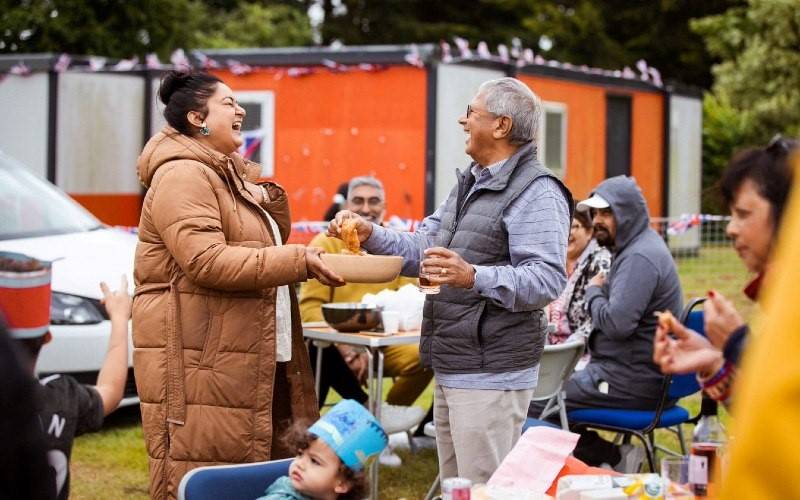
It really is as simple as saying hello. If there isn’t a WhatsApp group for your area, could you create one? Invite your neighbour in for a cuppa or to go on a dog walk together. Or why not hold a Big Lunch to bring people together?
The goal isn’t for everyone to be best friends, but for people to know where they could turn to for support if they need it.
Sharing is a superpower
One of the most important things a community can offer is a shared wealth of knowledge. This might be direct expertise or resources, or the ability to signpost what’s nearby – recommendations for a tradesperson, therapist or just being the one neighbour who’s kept the leaflet about when the green bin goes out.
Modelling what you’d like to see is a great place to start. Share with your neighbours that you’re happy for them to borrow your hedge trimmer, or that you’re up for babysitting. It might be something like offering to contact the council about a shared issue – support can come in many forms.
You don’t need to do everything, just create a space and others will fill it. That network of people coming together is immensely powerful. Establishing the practice of sharing your knowledge now means that should a crisis happen in your community, everyone’s already in the habit of helping one another, and knows who’s got which skills!

Lift people’s spirits
The power of lifting spirits is not to be underestimated. The world we live in feels quite scary. But being joyful is a surprisingly powerful antidote. In times of uncertainty, sometimes the best thing you can do is put a smile onto people’s faces.
Here are some ideas:
- Crocheted postbox toppers – these have sprung up in locations around the UK and bring joy and humour to neighbourhoods.
- Chalk drawings – invite people to have fun by drawing hopscotch or obstacle courses. You’d be surprised by how many people get involved!
- Little libraries – another popular community initiative springing up everywhere. Get yourself a box, decorate it, add a few books and some basic rules and off you go.
- Flowers – colourful planters, window-boxes and front gardens can cheer those walking past, so if you have the space, why not plant some flowers? Great for insects too! Brightly painted rocks and pots can have a similar cheering vibe if you’ve no space or time for gardening.
More community inspiration

What does community mean to you?
Community – it’s a word we all know well. But whether it’s the feeling of belonging in our neighbourhood or the support we offer…

10 ways to keep connected
Making someone’s day and reducing loneliness can start with the smallest of steps.

10 community ideas for Christmas
If you want to spread some cheer and lift the spirits of those around you, here are our favourite ten community ideas for Christmas…
Hungry for more?
Sign up to our newsletter for a monthly dose of fun ideas, handy information and inspiring good news stories.